
After receiving hundreds of speaker and session proposals earlier this year, the 2025 African Investigative Journalism Conference (AIJC) programme is now being finalised and promises to be one of the best editions yet, with a few surprises in store for attendees.
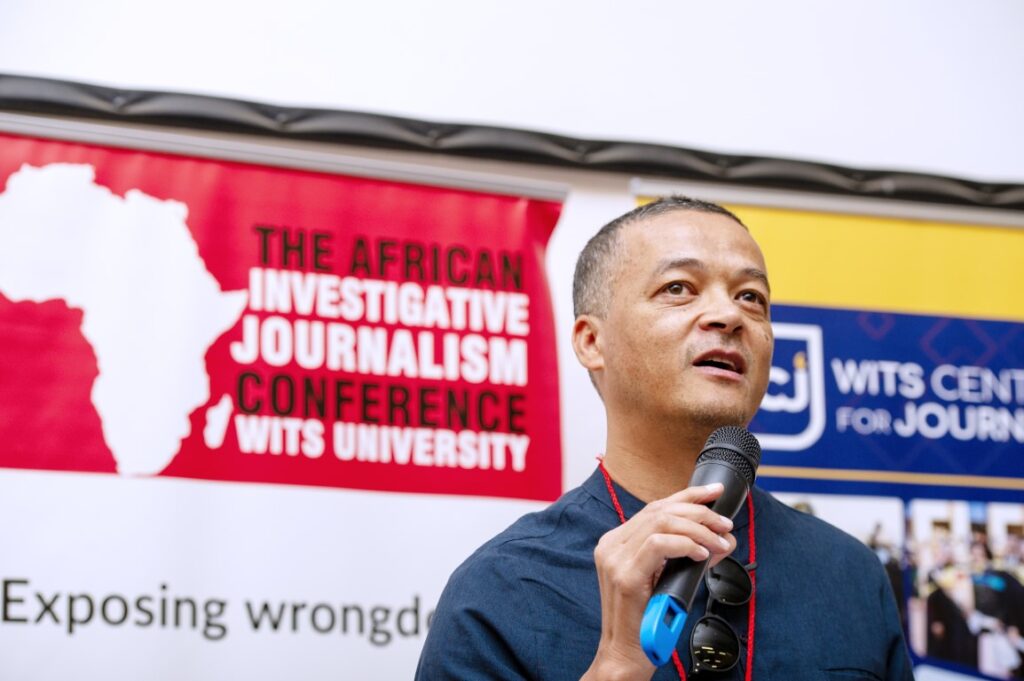
“This year we are once again privileged to host more than 500 of the continent’s best and brightest investigative journalists at the AIJC, now in its 21st year at Wits University,” says convenor Beauregard Tromp.
“The conference has evolved significantly over the years, always with the needs of our audience in mind. The most obvious growth point has been a greater mix of African journalists, many of them from francophone countries. As always, the conference will offer a wide range of training on everything from data wrangling, follow the money exercises, health, whistleblowers, journalists’ safety, innovation, migration and many more critical topics.”
Ahead of the official programme launch, you’ll find a glimpse below of some of the fascinating sessions and speakers to be featured at #AIJC2025. Keep an eye out for more speaker and session announcements in the coming weeks.
Illicit financial flows finance terrorism in the Sahel
Elie Kaboré (Burkina Faso), Investigative Journalist and Editor of minesactu.info
Terrorism has been threatening sub-Saharan Africa for decades. Terrorist attacks are on the rise in Nigeria, Niger, Mali and Burkina Faso. How do terrorists finance their actions? Who finances them? Where do they obtain their weapons and assets? Following an investigation, Kaboré was able to document a number of sources of funding, including begging, trafficking in illicit goods (drugs, counterfeit medicines), gold mining fraud, the sale of livestock, the sale of agricultural products and fertilisers for the manufacture of explosives, and the looting of army equipment (vehicles, drones, weapons and ammunition).
Investigating with AI: Tools, Tactics and the Role of NewsAssist AI in African Journalism
Elfredah Kevin-Alerechi (Nigeria), Founder: JournoTECH, The Colonist Report and The Colonist Report Africa
Artificial Intelligence is changing how stories are uncovered and reported, from data analysis to source protection. In this session, Elfredah Kevin-Alerechi will share how journalists can use AI to investigate stories, analyse large documents, and understand the power of NewsAssist AI — a platform built by JournoTECH with African journalists in mind. It supports investigations through secure transcription, ethical automation, editing, and fast content analysis. She will explore practical uses of AI in investigations, potential risks like surveillance and bias, and how journalists can navigate these challenges safely and responsibly.
Educating Under Siege: The Resistance of Girls in Conflict Zones in Northern Mozambique
Quinton Nicuete (Mozambique), Freelance Journalist
This presentation explores the struggle for educational rights among girls displaced by armed conflict in Cabo Delgado province, Mozambique. Drawing from field research, exclusive testimonies, and data gathered from resettlement centers, the study reveals how terrorism directly impacts access to education. It highlights resilience strategies adopted by affected communities and examines gaps and progress in public policy responses. The aim is to inspire deeper humanitarian coverage across African crisis zones.
Beyond Exposure: How Solutions-Driven Investigative Journalism Can Be a Shield, Not Just a Sword
Gregory Gondwe (Malawi), investigative journalist, editor, and media consultant
In 2022, Gregory Gondwe was arrested for exposing corruption in a government procurement deal. Months later, threats forced him into exile. Today, he leads one of Malawi’s most respected investigative journalism platforms and argues that journalism doesn’t always have to end in retaliation—it can also end in reform. In this powerful session, Gondwe will unpack how shifting from pure exposé to impact-oriented and solutions-driven investigations can not only serve the public good, but also provide a layer of safety for journalists working in hostile environments. Drawing from personal experience and mentoring work across Southern Africa, he makes a compelling case for how a well-targeted investigation—framed with possible remedies—can change the dynamic between journalists and those in power.
Fundamentals of photojournalism for investigative journalists
Nic Bothma (South Africa), Visual Editor at the Center for Collaborative Investigative Journalism
This workshop will equip investigative journalists, particularly freelancers and independents, with the skills to harness photojournalism as a powerful tool in their reporting. Participants will gain insights into the role of visual storytelling in investigations, along with practical techniques, tips, and resources to strengthen the photographic dimension of their work.
Investigating critical minerals in Southern Africa
The Oxpeckers Center for Investigative Environmental Journalism (Southern Africa)
This panel discussion will explore Oxpeckers’ #PowerTracker coverage of critical minerals as part of the energy transition – highlighting the work of journalists supported by #PowerTracker, an award-winning geo-journalism tool that tracks and shares information on South Africa’s Just Energy Transition, across Southern Africa. This coverage includes investigating the mining of minerals that are considered critical for the energy transition and the impacts on communities, as well as what this growing and transitioning sector will look like as the global energy transition unfolds. Oxpeckers Investigative Environmental Journalism, as Africa’s pioneering investigative environmental journalism unit, has been taking the lead in reporting on the Energy Transition and the Renewables Revolution in Southern Africa since 2022 with #PowerTracker. #PowerTracker maps renewable energy projects across the country and supports investigative journalism across Southern Africa.
Sustaining the Story: Revenue, Collaboration, and Innovation in Nonprofit Investigative Journalism
Nkosikhona Dibiti (Zimbabwe), Founder and Executive Director of Community Podium
How can nonprofit and under-resourced newsrooms survive and thrive in today’s challenging media landscape? Drawing from fieldwork in Zimbabwe and research at the Walter Cronkite School of Journalism and Mass Communication at Arizona State University, this session will explore practical revenue diversification models, collaborative reporting strategies, and innovative newsroom approaches. It will highlight lessons from producing high-impact investigative work under threat, using tools like cross-border story syndication.
Keep an eye out for more speaker and session announcements in the coming days and weeks. The 21st African Investigative Journalism Conference will take place from 5 to 7 November at Wits University in Johannesburg.
> Follow this link to purchase tickets.