

The 2026 African Investigative Journalism Conference has ended in Nairobi, Kenya. Held outside the borders of South Africa for the first time, the conference, hosted by the Wits Centre for Journalism (WCJ) in collaboration with Kenya’s Aga Khan University, drew over 500 delegates from 69 countries across the world, topping all previous attendance records.
Of these, 336 delegates said this was the first time they were attending the conference.
Countries in attendance:
Angola, Australia, Bangladesh, Benin, Bosnia and Herzegovina, Botswana, Brazil, Burkina Faso, Burundi, Cameroon, Central African Republic, Chad, Colombia, Costa Rica, Côte d’Ivoire, Democratic Republic of the Congo, Republic of the Congo, Denmark, Egypt, Eritrea, Ethiopia, Finland, France, Gambia, Germany, Ghana, Greece, India, Indonesia, Ireland, Italy, Jordan, Kenya, Lebanon, Liberia, Madagascar, Malawi, Mali, Mozambique, Myanmar, Netherlands, Nicaragua, Niger, Nigeria, Norway, Palestine, Portugal, Qatar, Rwanda, Senegal, Sierra Leone, Somalia, South Africa, South Sudan, Spain, Sri Lanka, Sudan, Sweden, Swaziland, Tanzania, Thailand, Togo, Tunisia, Uganda, United Kingdom, United States, United States Minor Outlying Islands, Zambia, Zimbabwe.
Artificial intelligence (AI) dominated discussions in the three-day programme with close to 150 speakers. Africa Uncensored co-founder and investigative journalist, John-Allan Namu opened the conference with a keynote on AI. His speech, titled AI: Power, Promise and Peril, examined who is telling the story of AI globally, how the AI race runs on the wealth extracted from Africa, and the need to measure AI not on the jobs it can replace, but by the people it can enable.

Subsequent sessions examined gender bias and accountability in AI, the abuse of power by big tech companies, as well as practical applications of machine learning, satellite imagery and AI-assisted data analysis in investigative reporting. Workshops also explored how journalists and editors can incorporate AI tools into their work responsibly.
Environmental and human rights activist Kumi Naidoo opened day two offering a broader perspective on the urgent global challenges facing society, the intersectionality of these challenges, and the role journalists must play.
“… most importantly, if we want to communicate with people around the world in an accessible way, we cannot use inaccessible language, talking in big words or policy terms and aiming all our messages at the brain – we must incorporate the heart and soul and harness the power of arts and culture in order to move people on the scale that we need to foster global action,” Naidoo said.
Other major themes included environmental accountability, organised crime, corruption, health reporting, as well as critical minerals and the exploitation of natural resources in Africa. The 2026 programme again addressed the increasingly difficult working environment journalists face on the continent, with discussions on journalist safety, exile, strategic lawsuits against public participation (SLAPPs), legal intimidation and the financial sustainability of independent newsrooms. Rising to the Challenge: Lessons and Networks from MENA’s Frontline Reporters, explored the experiences of journalists working in challenging environments across the Middle East and North Africa.

This year’s annual Carlos Cardoso Memorial Lecture, hosted by the Wits Centre for Journalism in collaboration with the Committee to Protect Journalists (CPJ), cast a spotlight on the Eritrea 16, a group of journalists imprisoned in 2001 without charge or trial following the country’s crackdown on independent journalism. They remain some of the longest-detained journalists in the world.
Eritrean journalist and former political prisoner Yirgalem Fisseha joined Jodie Ginsberg, CEO of CPJ, in conversation, and paid tribute to her disappeared mentor, Amanuel Asrat, one of the Eritrea 16.
“For a quarter of a century, families have been denied answers about their loved ones. The Eritrea 16 deserve recognition for their journalism, not for their decades of disappearance,” said Ginsberg.
The 2026 conference was preceded by a Masterclass in data journalism and OSINT tools which saw 23 fellows supported by Deutsche Welle Akademie participate in training provided by Bellingcat on 7-9 November.
The WCJ’s Africa-China Project also hosted a training workshop with fellows from across the continent to improve their skills on reporting on issues facing Africans due to Chinese industrial operations. This year, as part of its collaborative programme with OsloMet University in Sweden, the WCJ hosted a group of seven master’s students from Wits University, University of São Paolo, OsloMet and City University New York at the conference.
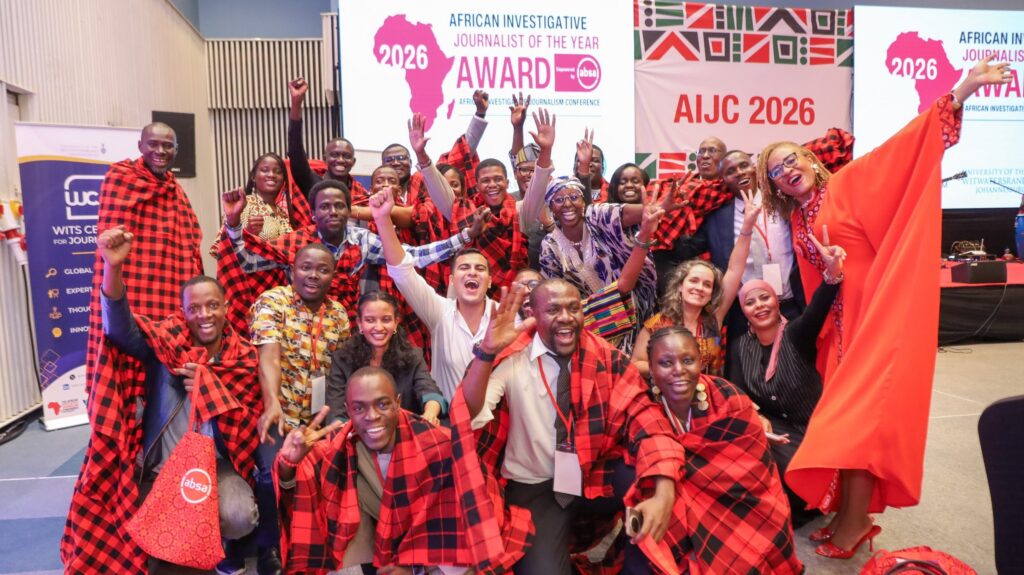
One of the highlights of the conference was the annual African Investigative Journalist of the Year Award supported by Absa, now in its fourth year. The keynote at the gala dinner was delivered by journalist and editor Khadija Patel, who reflected on the current state of journalism. Patel, along with Tidian Sy, Maggie Michael, Gwen Lister, Fernando Lima, and Beauregard Tromp, formed the panel of judges for the awards.
South Africa’s Jeff Wicks took top honours while first runner-up award went to Folashade Ogunrinde and Oladeinde Olawoyin of Nigerian news outlet Premium Times, in collaboration with The Examination. Second runners-up were Kenya’s Naipanoi Lepapa in collaboration with Julia Lindblom of Göteborgs-Posten and Ahmed Abdigadir of Svenska Dagbladet in Sweden for Your Eyes, their Data.
“I am overwhelmed at the response to this year’s conference. Nairobi welcomed us with open arms and our African investigative journalism community responded to the call to meet in East Africa,” said Dr Dinesh Balliah, Director of the Wits Centre for Journalism.
“This conference showcases the best in investigative journalism on this continent and signals to the world that we are here and we have much to offer despite the many challenges we face. There is a spirit of defiance among this community that despite the odds, we will continue to hold power to account,” said Balliah.