
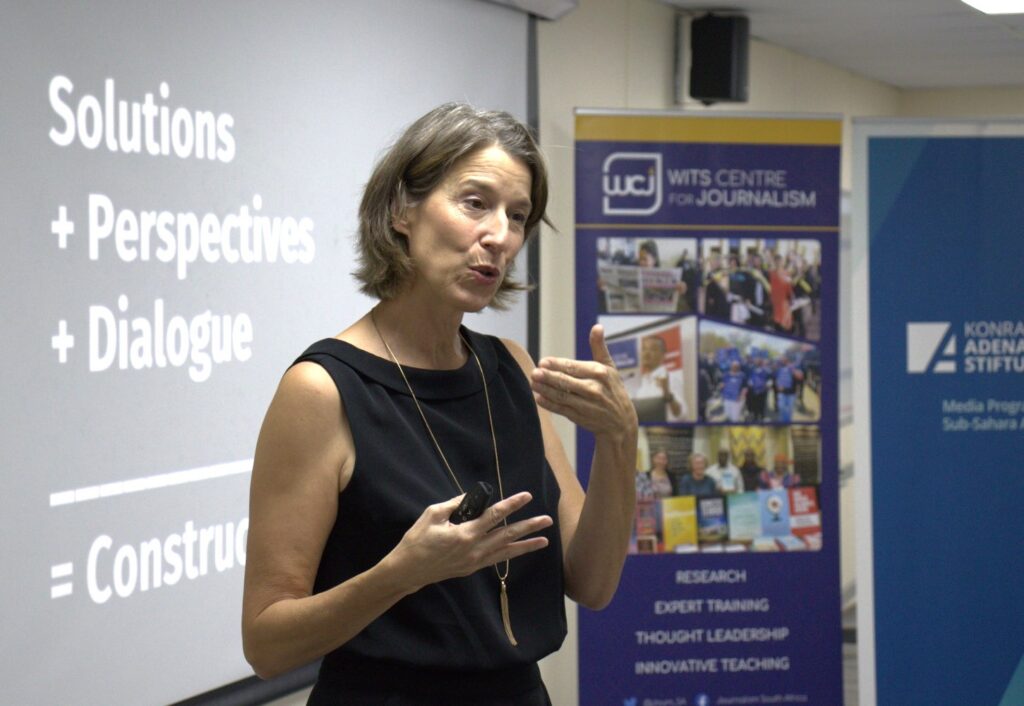
As artificial intelligence transforms how information is produced and consumed, the future of journalism will depend on qualities that technology cannot easily replicate: human understanding, empathy, curiosity and the ability to navigate complexity clearly and accurately.
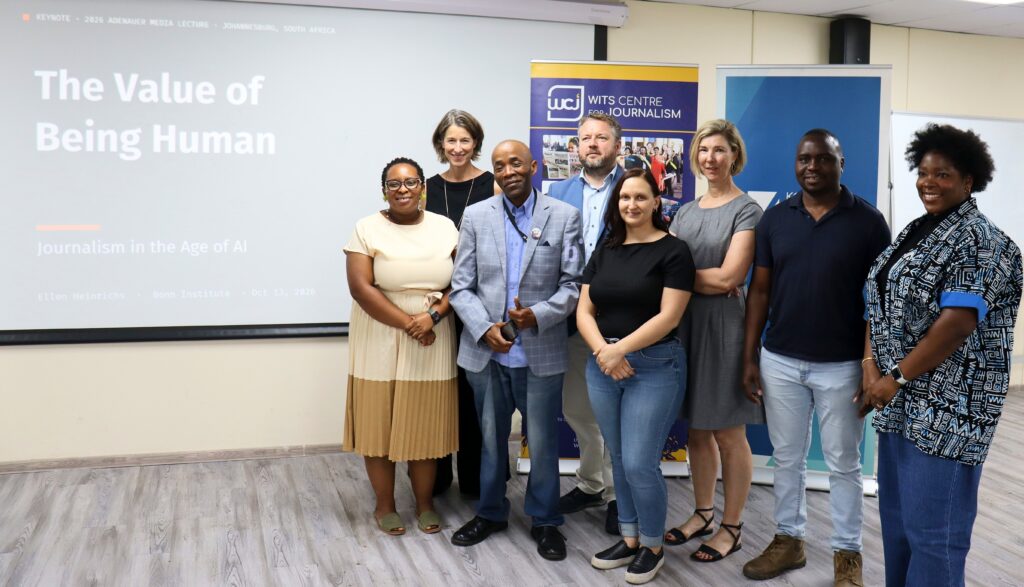
This was the key argument made by founder and CEO of the Bonn Institute, Ellen Heinrichs, during her keynote address at the 2026 Konrad-Adenauer Stiftung Media Lecture hosted by the Wits Centre for Journalism (WCJ) at Wits University on 13 October.
A journalist by profession, Heinrichs previously worked at German news service Deutsche Welle, where she founded the broadcaster’s journalism lab. She later established the Bonn Institute to promote more constructive, human-centred approaches to journalism, with her background in mediation informing her work on how journalism can cover conflict while helping societies better understand different perspectives.
Heinrichs argued that journalism’s challenge in the age of AI is to establish why audiences should turn to professional journalism when information is increasingly abundant and available instantly.
“We need to better understand what matters to the people we are trying to serve,” she said.
An information crisis is also a crisis of trust
“AI-generated websites mimicking legitimate publications, the proliferation of disinformation, and the speed at which synthetic content can be produced are all making it harder for audiences to distinguish credible journalism from AI slop. AI-powered search tools are now delivering answers directly to users, reducing the traffic that news organisations have traditionally relied upon through search engines.”
This challenge is compounded by growing news avoidance. Citing the Reuters Institute’s Digital News Report as a local example, Heinrichs noted that 42% of English-speaking respondents in South Africa said they sometimes or often avoid the news – the same proportion as the global average.
“More than half of those surveyed who avoid news cite its excessive volume and depressing nature as reasons for disengaging. Audiences also feel that journalism does not represent their experiences, use accessible language or address the issues that matter to them,” said Heinrichs.
Constructive journalism goes beyond reporting what is wrong
For Heinrichs, one solution is practicing constructive journalism, an approach that retains journalism’s critical role while broadening its focus to include possible responses to the problems it investigates.
She stressed that constructive journalism is not a substitute for investigative reporting or holding those in power accountable. Rather, it adds another dimension to journalism by examining what happens after a problem has been identified.
“Traditional reporting can provide a detailed account of a crisis, its causes and those responsible. Constructive journalism poses additional questions in asking who is addressing this problem, what can be learned from their efforts, and what evidence exists that their approach works,” said Heinrichs.
She used an example of a German newsroom investigating the decline of a city centre that had experienced years of empty cafés and shops due to crime and other issues. Rather than continuing to document the decline, journalists examined the neighbouring Dutch city of Venlo, where a more vibrant city centre offered a potential alternative.
“The newsroom investigated what Venlo had done differently and reported its findings. The coverage subsequently prompted local discussion about whether similar approaches could be applied elsewhere. Using this example, journalists can investigate how a proposed solution works, what evidence supports it, where it falls short and whether it could be replicated in another context.”
For Heinrichs, this approach offers public value and an editorial opportunity. Audiences may have less interest in problems affecting distant communities, but they can be deeply interested in how others have tackled challenges they themselves face.
Human-centred reporting starts with listening
Constructive journalism forms part of a broader approach that Heinrichs and her colleagues at the Bonn Institute advocate – journalism that reflects on its own assumptions and represents a wider range of perspectives, while creating opportunities for meaningful dialogue.
Journalists, she argued, cannot assume that their own understanding of what matters is universal. In diverse societies, people may experience the same issue very differently, and those differences should be reflected in the reporting.
“Journalists should ask themselves, ‘who is missing from this story?’ And instead of focusing exclusively on who is to blame and how a situation deteriorated, explore what improvement would look like. Who is already doing something differently, and what lessons might be transferable? Journalists must resist the assumption that negative outcomes are the only stories worth telling.”
Dialogue is equally important. Heinrichs warned that journalism can contribute to social polarisation when it focuses predominantly on conflict and division. By creating spaces for people to hear different perspectives, identify common ground and engage with difficult issues, journalists can help audiences understand one another without pretending that disagreements do not exist.
Journalism as a source of social cohesion
The opportunity here is for journalism to also serve as a source of social cohesion.
Heinrichs cited the 2025 German study What Holds Society Together and What Public Media Contribute, in which 80% of respondents said they wanted journalists to contribute to social cohesion, while only 40% believed journalism was actually trying to do so.
For news organisations facing declining trust, news avoidance, and competition from AI, addressing this disconnect is vital to maintaining long-term relevance and sustainability.
“Journalists are very often perceived as the people who are driving our societies apart. But in an era where tech billionaires own all our news platforms and with many politicians amplifying divisions, there is a space for someone, maybe you, to be the glue in our societies, which would be very relevant and very precious for a lot of people,” she said.
Heinrichs acknowledged that newsrooms face significant time and resource pressures, often making widespread changes to established practices unrealistic. Instead, she said journalists and editors can make these incremental improvements in asking better questions, reflecting on personal biases, seeking out missing voices and routinely investigating potential responses to the problems they cover.
The future of journalism in an age of AI depends on how well journalists listen, question, connect and help audiences make sense of the world.