
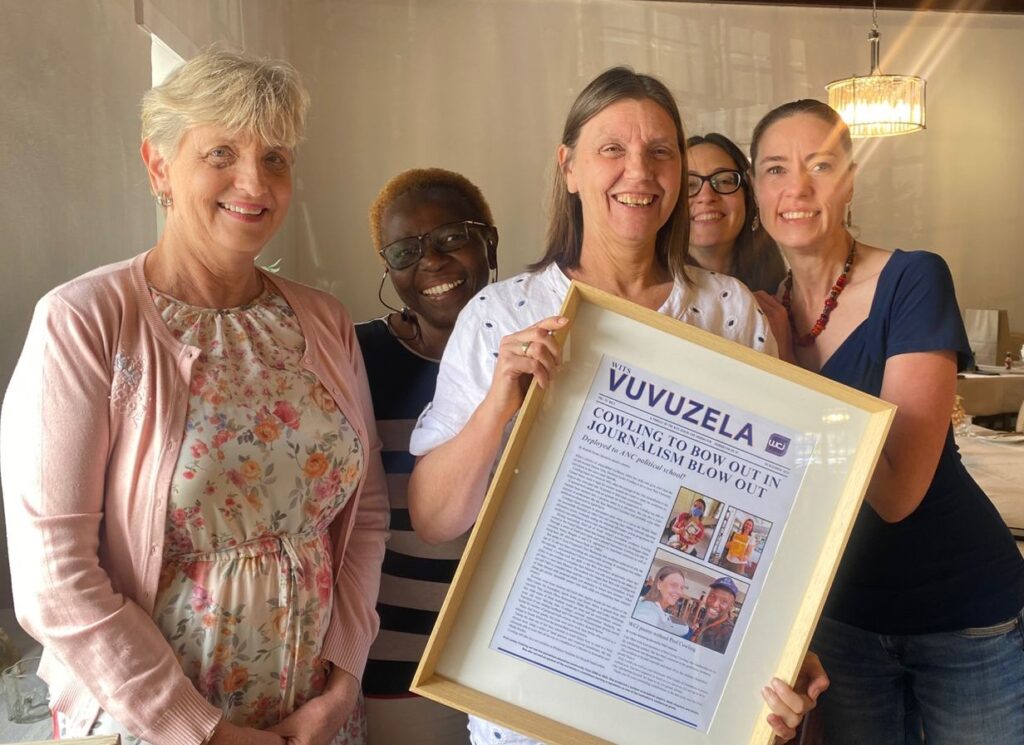
The Wits Centre for Journalism bids a heartfelt farewell to Prof Lesley Cowling, who retires in 2025 after a remarkable 25 years at Wits University.
As one of Wits Journalism’s founding leaders, Prof Cowling was instrumental in guiding the Centre to where it is today, carefully curating the academic programme over the years.
When I started at Wits, in a new degree called the MA in Journalism and Media Studies, we were moving into a new millennium. The internet had been around in a limited fashion for 10 years, initially only in newsrooms, not at home. I had started using email at work in 1995 (thanks, Sunday Times!) and got my own home dial-up email and internet in 1997. I had barely had a cellphone for five minutes and it was a heavy brick.
The journalism sector was dominated by big commercially successful companies, such as the Independent Group, Times Media, Caxton and Naspers, and the SABC was a behemoth, dominating the broadcast environment. But everything was in transition – change wherever we looked.
It was in this environment that we were tasked with building a set of journalism degree programmes for Wits, which had never before had a media or communications programme, or even coursework MAs. It was ground zero. We were a bunch of journalists – myself, Anton Harber, Joanne Richards and Franz Krüger – muddling about in academe, a space which offered many possibilities, but was also somewhat of a mystery to us. Under the guidance of Professor Carolyn Hamilton, we tried to figure out what a degree in journalism – located in the critical space of a university – could contribute to the South African media sector.
The first key decision we made was that the degrees should be postgraduate, and that they should serve working journalists. Entry-level “career-entry” students with degrees in any subject could come in and learn journalism skills at the honours level, but the other degrees should be for journalists (and later, communicators) who had worked in the media sector for some years. This choice, although we did not know it at the time, set us up to have satisfying and stimulating careers as teachers and supervisors, as interaction with passionate mature students is a privileged position for an educator. Looking back over 25 years of courses taught, I remember spaces in which I learned as much as the students, lively debate and a lot of laughter. Yes, journalists love a good joke, and the witticisms and playful joking kept flowing.
The second important decision was to introduce a Recognition of Prior Learning (RPL) route into the mid-career honours programme. In the 2000s, there were many journalists who had been denied a university education through apartheid policies. Some had been trained on the job, others in technical colleges (some of which were very good), but still hankered for an academic degree from a university.
The mid-career honours provided entry to such students. For 25 years, we have seen them grab the opportunity, gaining their first degree, many moving on to the Master’s programme, and even some going on to PhDs. The commitment of the students to the process (even learning how to reference properly) and their stoicism under pressure of their studies and their working and family lives has been inspiring to watch.
Finally, looking back, I remember the era when donor funding brought students from other African countries into Wits Journalism. An elite and talented cohort of working journalists thrived in our programme, bringing enlivening classes with news of countries such as Cameroon, Nigeria, Kenya, Liberia, Ghana, Malawi, Zambia, Uganda, Sierra Leone, Botswana, Lesotho and Swaziland. And, last but not least, the constant stream of Zimbabweans signing up year after year. The Wits Centre of Journalism alumni span the globe, many still in contact with each other in a collegial network in which, of course, the wit and humour flows.
The act of looking back brings certain things into sharp focus and – faced today with the twin challenges of a digitised world and a struggling media sector – I feel that I lived through a kind of golden era, an idealised place of contemplation, creativity and growth. But I also know that the Centre will continue to hold that space open, and that our graduates will continue to make a difference in the wider world.
The Wits Centre for Journalism sincerely thanks Prof Cowling for her years of dedication and teaching excellence, and wishes her all the best during this new chapter.