
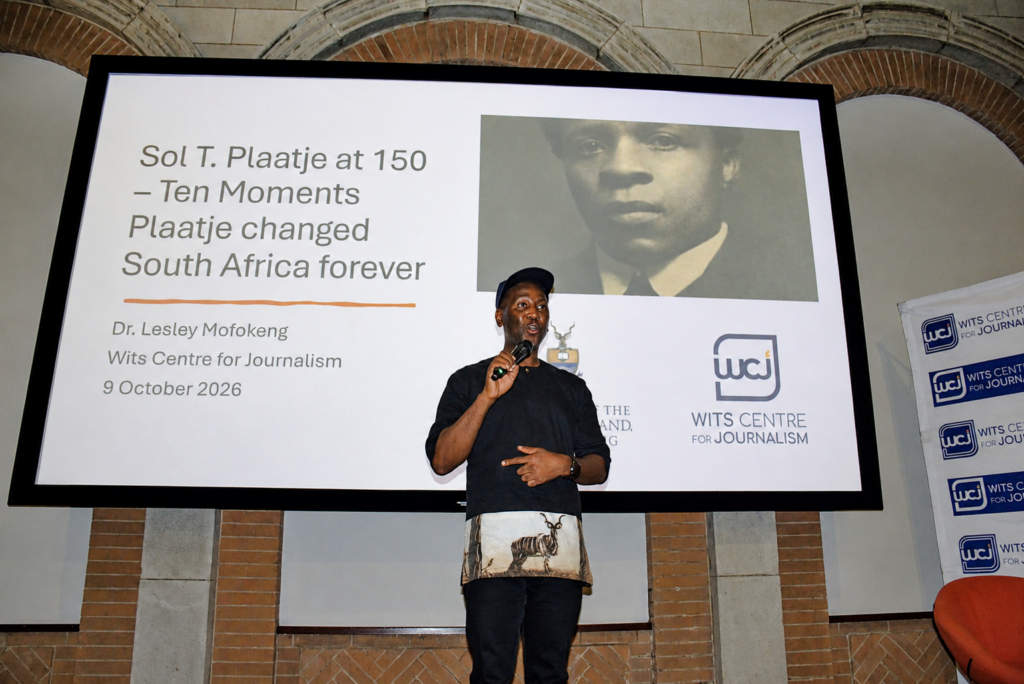
Solomon Tshekisho “Sol” Plaatje produced a body of political and intellectual work that few subsequent South African thinkers have been able to match, whether in journalism, politics or civic activism.
This was argued by Wits Centre for Journalism (WCJ) alumnus and Plaatje scholar Dr Lesley Mofokeng during a symposium held at Wits University on 9 October, celebrating the enduring legacy of Plaatje on what would have been his 150th birthday.
The event, arranged by Mofokeng and hosted by the WCJ, was a heartfelt affair which included colleagues, friends and academics from Wits and other South African universities who gathered to share their research and insights into various facets of Plaatje’s life.
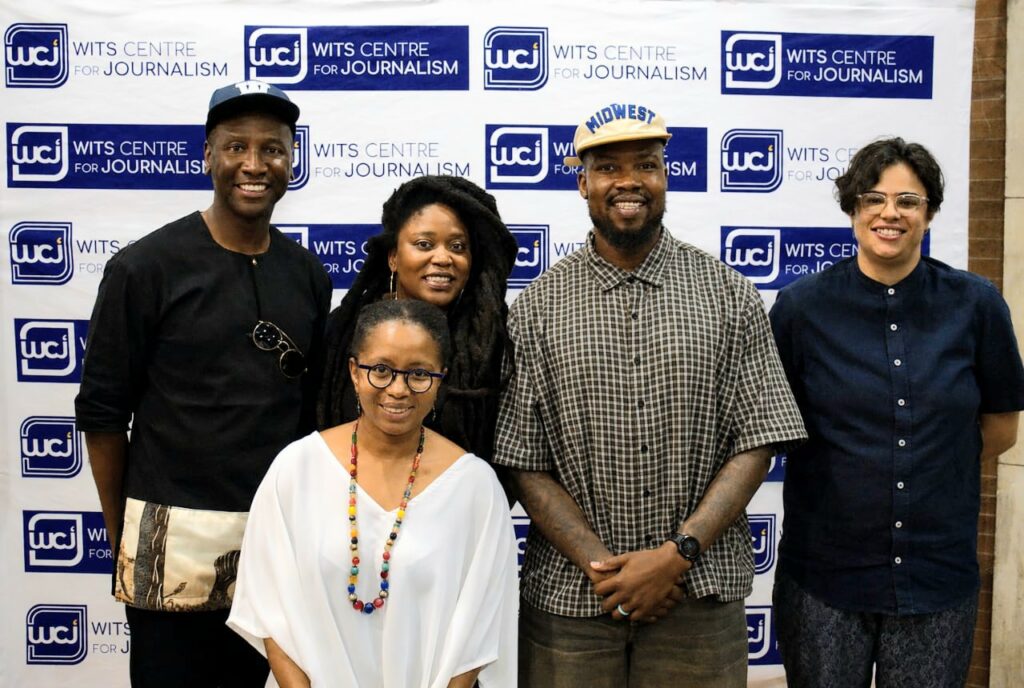
Back row: Dr Lesley Mofokeng (Wits), Dr Refiloe Lepere (Wits), Dr Otshepeng Moletsane (Unisa), Dr Tara Weinberg (Wits). Front row: Dr Lebogang Mokwena (University of Cape Town).
Dr Otshepeng Moletsane of Unisa explored the impact of Plaatje’s collection of Setswana proverbs in how he argued with colonial power, while Historical Studies lecturer at the University of Cape Town Dr Lebogang Mokwena and Wits Foundation Studies lecturer Dr Refiloe Lepere looked beyond Plaatje’s body of work into the strong foundations that his wife Elizabeth “Lilith” M’belle provided at home, noting that for Plaatje to have such a prodigious life, he needed to have been anchored domestically.
Dr Tara Weinberg of the Wits History Department presented on the networks Plaatje operated within, particularly the important role that land played in the ideas he and his contemporaries held in viewing land ownership as a fundamental human and economic right for black South Africans, rather than a privilege to be doled out by a colonial government.
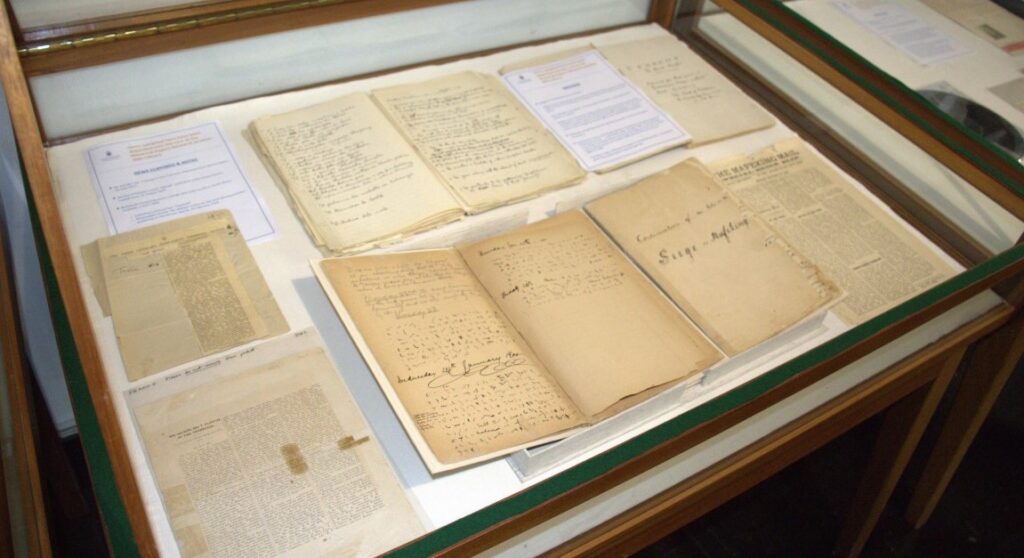
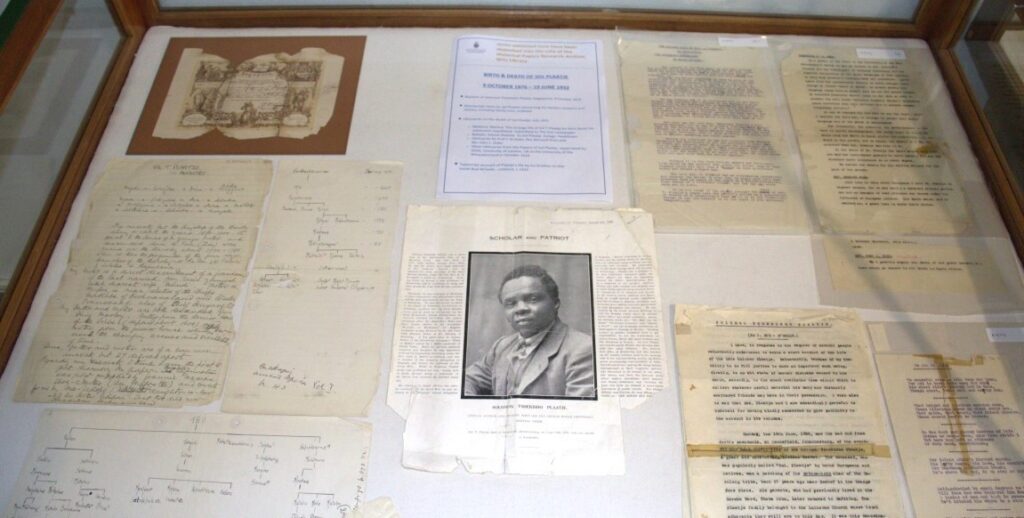
Treasured items from Plaatje’s life housed at the Wits Historical Papers Research Archive, were also on display, including rare photographs, original manuscripts, and his Canadian passport, while Plaatje’s rendition of South African hymn Nkosi Sikelel’ iAfrika recorded in London in 1923 played in the background.
“My love for Plaatje has been nurtured by my academic colleagues here at Wits, especially Kevin Davie, who supervised my master’s dissertation, and convinced me that The Mafeking Diary of Sol Plaatje was the best book ever written by a South African,” says Dr Mofokeng.
Mofokeng went on to complete his PhD in 2025 with his thesis, Sol T. Plaatje’s Ink: Exploring the nascent Setswana public sphere through the form of Plaatje’s newspapers (1901–1915).
Inspired by what he uncovered during his research, Mofokeng compiled a list of ten moments he believes Plaatje changed South Africa forever.
Moment 1 – The Mafeking Diary
While working as a court interpreter during the Siege of Mafeking, Plaatje wrote what is now known as the Mafeking Diary, his private reflections from October 1899 to March 1900 around the South African War (also known as the Boer War, and primarily considered a “white man’s war” for many decades). It was only after Plaatje’s diary was rediscovered and published in 1973 that the narrative changed, noting the involvement of black South Africans. Where official war records failed to record how up to five black South Africans were dying a day from starvation, they did note how the garrison’s horses were fed. Mofokeng argues that Plaatje’s diary ultimately defined the journalism he became known for in using parallel evidence, comparative data, and documenting discrepancies.
Moments 2 & 3 – The founding of Koranta ea Becoana and the development of investigative accountability journalism
Plaatje founded Koranta ea Becoana, the first wholly black-owned and controlled newspaper in South Africa that received no subsidy from white political parties or business backers. “This gave Plaatje editorial independence and allowed the development of investigative and accountability journalism, where he held the feet of authorities by the fire and asked them difficult questions. Investigative accountability journalism stands as a black South African intellectual practice,” says Mofokeng.
Between 1901 and 1909, Plaatje conducted four bodies of accountability journalism that preceded the formalisation of investigative journalism as a professional genre in North American scholarship.
Moment 4 – Two languages and two philosophies
According to Mofokeng, the English and Setswana columns of Plaatje’s newspaper are different arguments, made from different philosophical traditions, for different audiences, towards the same political goal.
In his Setswana writing, Plaatje drew on an African philosophical framework. The constitutional arguments in the English columns engaged with the language and conventions recognised by the colonial establishment – arguments that its authorities could respond to, dismiss or delay. The proverbs and culturally embedded reasoning of the Setswana columns operated beyond the boundaries of that colonial intellectual framework.
“This demonstrates that African languages contain philosophies that the European philosophical tradition cannot access, replicate or refute, and Plaatje used this to his advantage,” says Mofokeng.
Moment 5 – The Maitisho column
Written in a female voice for women within the Setswana-speaking community, the “Maitisho” column addressed tensions within marriage, the disruption of traditional domestic life under colonial rule, the diminishing authority of women as established community structures were destabilised, and the struggle to preserve women’s dignity in contexts designed to undermine it.
“Scholars who have noticed the Maitisho column have speculated that it was Plaatje’s voice, adopting a female editorial persona to address what a male editor, under his own name, could not address within the social conventions of the era,” says Mofokeng.
The column produced a sustained feminist political journalism that preceded many equivalents in the South African black press by decades.
Moment 6 – Newspaper as the infrastructure of liberation
On 8 January 1912, the South African Native National Congress (SANNC), which would later become the African National Congress (ANC), was established. Plaatje selected the date and was appointed the organisation’s first General Secretary. By then, he had already spent 11 years establishing himself as one of the country’s most influential black journalists.
“The newspaper he founded later in 1912, Tsala ea Batho (Friend of the People) became the organ of the new organisation,” says Mofokeng. “It published the SANNC’s resolutions, analysed parliamentary debates that affected African interests and provided the communication infrastructure through which the early liberation movement maintained its coherence across the geographical dispersal of its membership.”
Moment 7 – Theory of civil disobedience
In June 1913, Tsala ea Batho published an editorial that was an instruction to civil disobedience. As women of Waaihoek in Bloemfontein marched against passes, Plaatje wrote: “Let no woman pay a fine. Let them build new gaols. It is no disgrace to occupy them for your liberty.”
Mofokeng notes that this was 39 years before the ANC’s Defiance Campaign adopted civil disobedience as a liberation strategy. “The 1913 campaign produced what scholarship has not connected to it: the Bantu Women’s League (1918), the legislative exclusion of women from pass laws (1923) and the foundation for the 1956 march on the Union Buildings. The 1913 women walked first and built the road on which 1956 walked.”
Moment 8 – Field journalism and the counter archive
On 19 June 1913, the Natives Land Act came into force. Sol Plaatje got on a bicycle and crossed the border from the Cape Colony into the Orange Free State in the days that followed. He found families being driven off the land that the Act had declared white-only territory.
This method was field journalism – the journalist going to the source, without institutional support or editorial budget, with the thinking that if he does not record this suffering, the record of what the Land Act did to people would not exist.
The bicycle journey produced the journalism that became Native Life in South Africa, published in London in 1916 and is the most extended act of investigative advocacy journalism in the history of the South African early black press and the text that brought the Land Act’s consequences to international attention.
Moment 9 – The voice in the archive
On 16 October 1923, Sol Plaatje recorded Nkosi Sikelel’ iAfrika in a studio at Hayes, Middlesex. It is the first known archival recording of the hymn that would become the central anthem of the liberation movement and the national anthem of a democratic South Africa and Tanzania, while Zambia uses its melody.
“On a doomed advocacy trip to England to petition a British government that had made clear it would not intervene in South Africa’s native policy, Plaatje committed the song to wax. He was preserving the future he would not live to see,” says Mofokeng.
Moment 10 – The full body of work: an unmatched intellectual
“No South African thinker of the 20th century has produced a body of work that matches it in breadth, rigour and consequence,” says Mofokeng.
His achievements encompassed his diary of the South African War; three newspapers published over a 15-year period, together preserving an extensive record of black community life in the early twentieth century; Native Life in South Africa; the novel Mhudi; a collection of hundreds of Setswana proverbs; a phonetic study of Setswana co-authored with Daniel Jones of University College London; translations of Shakespeare into Setswana; and an enduring musical recording.
“This is a description of a specific intellectual programme. It is a demonstration, across multiple genres and multiple languages, that African intellectual life was as complex, as philosophically rich and as culturally ambitious as anything the European tradition had produced.
“Plaatje achieved this under conditions that would have defeated a lesser person. He was largely broke, spent years in England and North America making arguments that the governments he addressed were not prepared to act on. He watched the Land Act dispossess his people and saw the world largely fail to respond but he kept working,” asserts Mofokeng.
“The hardest thing to acknowledge about Plaatje’s story is that many of the political goals of his journalism were not achieved but the community he convened produced the political formation that eventually dismantled the system he could not.”