
Johannesburg – How are humans asserting themselves in the time of technofeudalism? This is the question more than 150 academics and communication professionals looked to answer at the annual South African Communications Association (SACOMM) conference, held at the University of the Witwatersrand from 9 – 11 September, hosted by the Wits Centre for Journalism.
Under the theme of Asserting the Human in the Time of Technofeudalism: Global South Perspectives, scholars and educators from 19 institutions across southern Africa, together with multiple journalism and communications practitioners, presented and debated new and recent research looking at how African audiences, developers and scholars are engaging with technology.
“In this context, where a few platforms significantly determine access to information, markets, cultural visibility, and even social existence, it is necessary to consider the wider impact on humanity,” said head of the 2026 SACOMM organising committee and WCJ lecturer Dr Collen Chambwera.
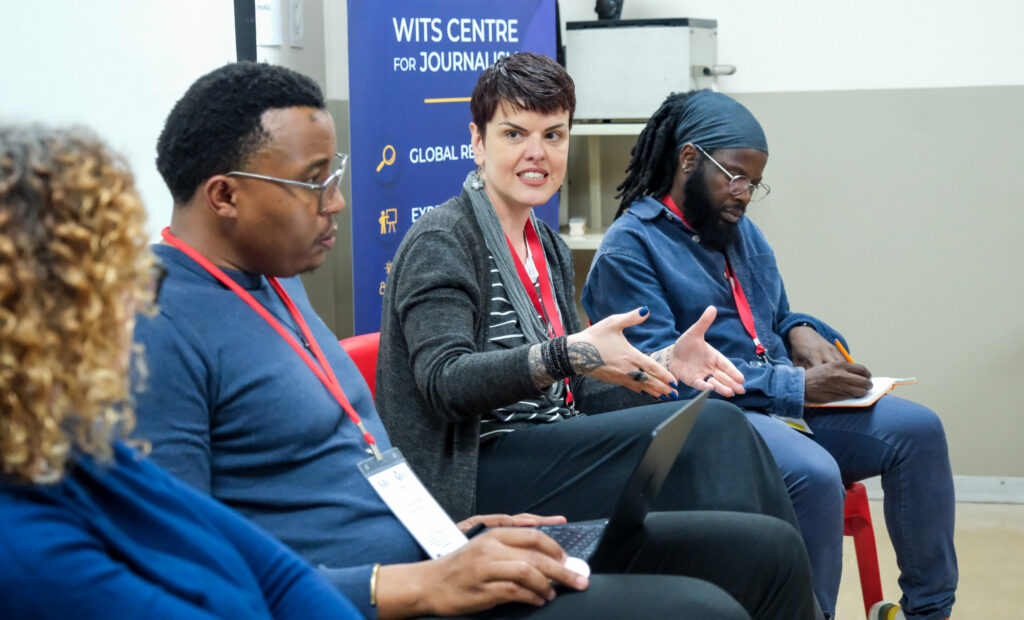
Dr Paola Prandini of the Wits Centre for Diversity Studies joins a panel discussion. Image: Hannah Brown
Technology must remain accountable to people
In his opening address at the conference, Deputy Vice-Chancellor of People Development and Culture at Wits University Professor Garth Stevens emphasised that the convenience of technology must not eclipse our autonomy, and that as individuals we must continue to “assert the human”, taking accountability for our lives, our work and our processes.
“To assert the human is not to reject technology or romanticise some pre-digital past, it is rather to insist that technology must be made accountable to human purposes, relationships, dignity and public good. It means defending something that is easily lost in an environment governed by metrics and optimisation,” Stevens said.
This thinking was evident across the three-day conference programme and academic presentations, which covered a range of topics including communications advocacy and activism, strategic communication and platform power, governance, human rights, education and curriculum development.
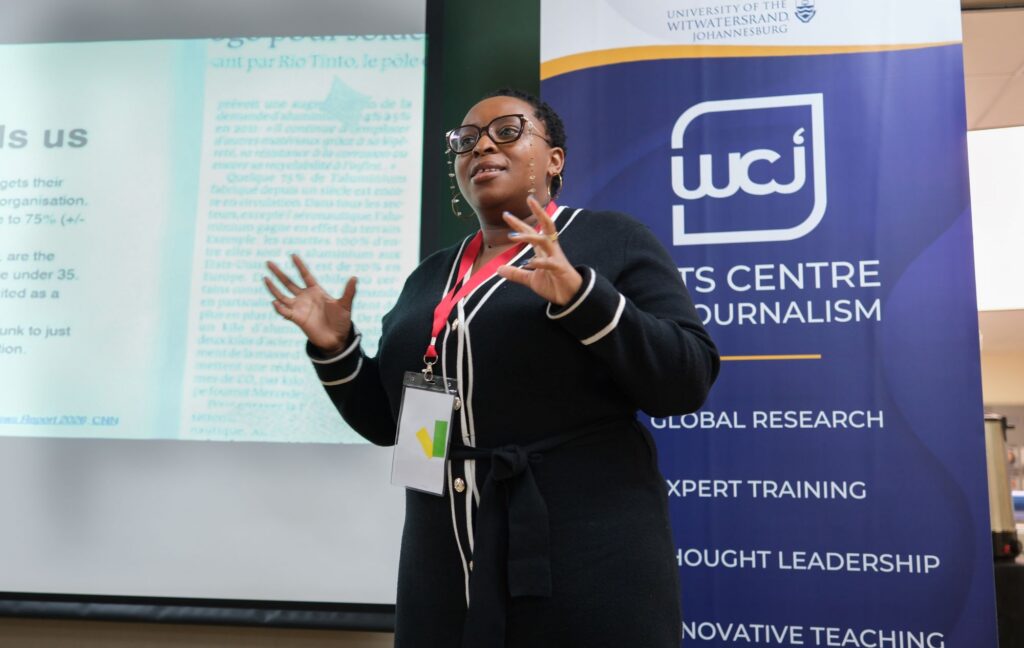
WCJ lecturer Pheladi Sethusa presents her latest research on the changing landscape of journalism in how people consume and present the news. Image: Hannah Brown
Communication, media and the struggle to assert humanity
SACOMM president Professor Sisanda Nkoala made the important observation that throughout South Africa’s history “asserting the human” has been a fight against systems that sought to “reduce us to numbers, commodities, or casualties” – whether this was against the dehumanising machinery of apartheid, a transition to market-driven global capitalism, the more recent #FeesMustFall movement, and the daily struggle of widespread gender-based violence.
“In every single one of those struggles, language, media, and communication have been the literal and figurative battlefield upon which our humanity was defended, and declared,” said Nkoala.
“In every epoch, to communicate is to refuse erasure; language is how we articulate our inner world, media is how we project our lived reality into the public sphere, and communication is the essential bridge that makes umntu ngumntu ngabantu [a person is a person through other people] tangible. To assert [the human] is to insist. It is to make a deliberate claim against an environment that threatens erasure. And as scholars of media, communication, and rhetoric, we know that asserting our humanity is not a new task,” Nkoala added.
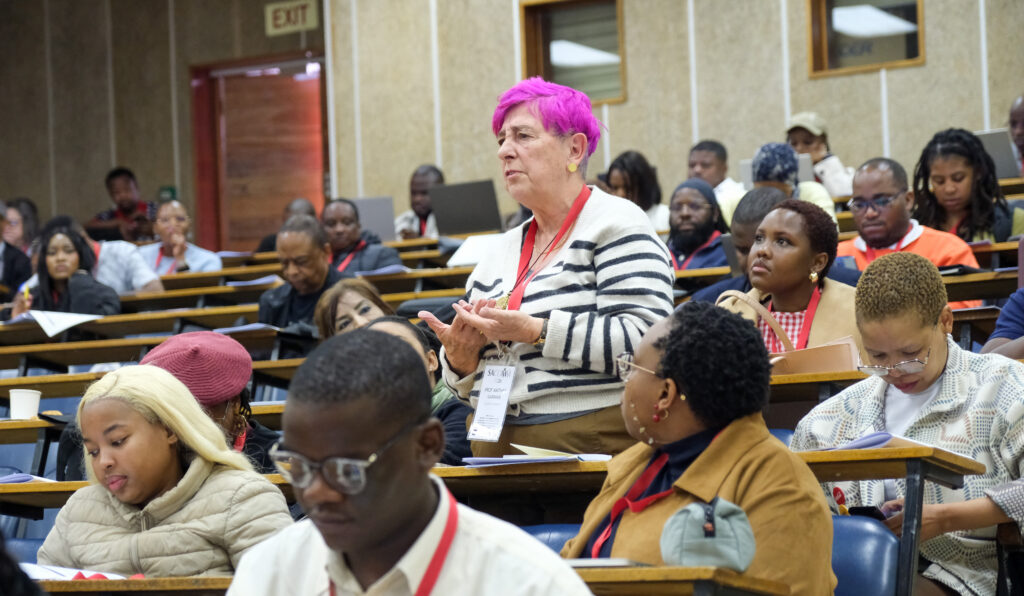
Prof Anthea Garman of Rhodes University engages with the panel during the opening plenary. Image: Hannah Brown
Professor Anthea Garman of the School of Journalism and Media studies at Rhodes University praised this year’s theme in prompting difficult but essential discussions.
“Some conversations have given me a bit of a shock. We tend to exist in academic bubbles where we explore great ideas, but confronting how these would really make a difference in the world as it stands right now, can feel overwhelming,” Garman said. “But in the same breath, having an academic direction in confronting these problems and sticking to it, asserting it, rather than caving, provides a corrective space we can build from.
“SACOMM has a history of providing a space for activism,” added Garman. “It might be opportune to again draw on the NGO and activist community and include them in these discussions.”
Emerging scholars bring new perspectives to SACOMM
Director of the Wits Centre for Diversity Studies Prof Nicky Falkof noted the “astonishing” work presented by the academic community’s emerging scholars at the conference this year.
“There are emerging scholars, many of whom are quite young, who are using their deep familiarity with digital platforms to develop and communicate a really nuanced and complicated understanding of how digitality is shaping contemporary life in South Africa and beyond. I think that is incredibly important,” Falkof said.
“It’s always inspiring to see this, and I think through this conference one gets a really strong sense of where the field is going, and what its broader applications are.”

Second year MA student at Rhodes University Kamvaletu Booi, who presented her research on “Digital Divides in Civic Communication: Comparing WhatsApp and Facebook Networks in Makhanda’s Water and Sewage Crisis”, found the conference inspirational.
“It was fascinating to learn more about what others in this community are researching. Seeing how they approached certain topics gave me a clearer idea of what I’m going to do when I tackle my PhD,” Booi said.
Fellow Rhodes University MA student Amahle Shosha presented practice-based research on “Exploring the Role of Radio Dramas in Shaping Discourses for Social Change in a South African Public Sphere”.
“It was very encouraging to see senior and established academics take such an interest in the work we’re doing as emerging scholars. Having that support is amazing,” Shosha added.
Reflecting on a successful #SACOMM2026, Nkoala thanked delegates for their collegiality, stewardship, and tireless commitment to the association.
“A heartfelt thank you to the Wits Centre for Journalism for curating such an academically rich and collegial event. We are grateful to everyone who has breathed life into this conference: our session chairs, technical teams, ushers, student volunteers and beyond. This conference has been the success that it has been because of you,” Nkoala finished.
Access the presentations from the 2026 SACOMM Conference.
The next SACOMM conference will take place at the Rhodes School of Journalism and Media Studies in 2027.